Showing posts with label suburbs. Show all posts

Friday, July 26, 2019

Pizza prosperity


Pizza Trust
Belvedere Square
529 E. Belvedere Ave

Pizza Club (not its individual members, but the disembodied collective voice of Pizza Club) does not like board games. Pizza Club does not understand board games. Why are they played? What is the source of enjoyment? Especially Monopoly. Monopoly makes us weep with mystification. We were reminded of this when reading up on America’s first Gilded Age, in the last decades of the nineteenth century, which served as the model for that dreaded game. It was a time of unbridled corporate power and greed, dominated by gargantuan trusts – Rockefeller’s Standard Oil, J.P. Morgan’s US Steel, the Northern Securities Company which briefly owned all the railroads from sea to sea – crushing workers and consumers alike under their heels.


The game of Monopoly, originally intended to make people question the moral legitimacy of this system, famously did the opposite and taught us that cutthroat real estate dealing is wholesome fun for the entire family – which it is, ask Jared Kushner. The abstracted pantomime of the “game,” where everyone starts equal and obeys the same rules, helps our brains accommodate the obscene exploitation of bodies and resources that we observe in the real world. When people threaten to take away the obscene exploitation of bodies and resources, that is called socialism, and it’s the most frightening thing imaginable. There would obviously be nothing left to do that is “fun” under those conditions.

These thoughts bubbled to the surface of Pizza Club’s melty cheesebrain as we visited Belvedere Square, a shopping center just inside the city’s northern limits. In that place has arisen the headquarters of a great Pizza Trust which claims to serve “Baltimore’s best pizza.” The Pizza Trust began operations about a year ago, which makes it quite remarkable that they have already received the designation of “best pizza” from the Pizza Oversight Authorities. Perhaps they acquired some smaller pizza company which came with this superlative, or perhaps the wheels of justice have been greased. Our investigators did turn up an unusual amount of grease, but we conclude that the Pizza Trust is in fact a whimsical evocation of corporate monopoly, and actually controls no means of production beyond the equipment and materials in its humble rented stall. We will first speak of these greasy materials, and then of the game in which the Pizza Trust merely occupies a square within a square within a square. Within a game board that is also just a square in a larger gameboard! Oh my god!


To set the scene, we should clarify that Belvedere Square contains numerous retail spaces arrayed around the large postmodern shed designated “Belvedere Square Market” (the rustic roof conceals a parking deck). The Market is modeled on the public markets of olden days, where various food producers would gather to sell their goods. In the early 1980s, white suburbanites nostalgic for the downtown public spaces they remembered but were afraid to visit built simulacra such as this. The Market offered heavily marked-up produce, meats, dry goods, etc. alongside prepared foods. Today, however, wealthy people have raw foodstuffs delivered to their homes in elaborate plastic sarcophagi; we don’t really know how poor people get food but many of them seem to still be alive. The only reason the bourgeoisie go outside is to visit food halls, and Belvedere Market transformed into the city’s first food hall in the early 2000s with a few gentle strokes of the Invisible Hand.


Though Pizza Trust is not the best pizza in Baltimore, it’s the best pizza we’ve had in a food hall. If in the future the city becomes one giant mixed-use megadevelopment with a food hall on the ground floor/pontoon level, we would nominate Pizza Trust to go there.

The Market Pie (a metonym for the place that used to sell vegetables but now sells only this prepared food with vegetables on it)

Don’t be appalled, dear reader, but Pizza Club doesn’t really want to write about pizza. You should know this by now. We are only continuing the work that began long ago, and will continue as long as cheese exists. Here it goes: the pies at Pizza Trust are oblong and would furnish a meal for two people. You could eat one by yourself if necessary. They offer a creative array of specialties, some quite beautiful in appearance, shimmering with greens, yellows, and reds.

The Mobtown
 The crust is thin, “gentle and light” but with “enough thickness and moisture to be satisfying,” forming a dynamic gradient from soft to crunchy. It has charred spots which release carbon flavor like delicate wisps of smoke. We experienced premium cheese and toppings and inventive use of sauces. Notably, the “Market” pie has a roasted red pepper and carrot sauce that pleased club members, providing the sweetness of a tomato sauce but with an unexpected rooty profile that compliments parmesan. The distance between pepperonis was just right.

Pepperoni (did not write down funny name)
 The specialty pies, though coherently planned around distinct flavor profiles, sometimes indulged in excess. The “Mobtown” balanced so many ingredients that they “rolled off the slice” and left the center of the pie rather damp. “Truffled white sauce” poured from a mushroom slice “like the frosting on toaster strudels.” The mushroom pizza is unpleasantly named the “Funcle”. Also, “truffled.” Why “roasted wild mushrooms” when you have roasted regular mushrooms? It’s fine to just say mushrooms. Your expensive words do not please us.

Funcle
 Quibbles must be aired through the Pizza Club consensus process, but in the end we were very happy with our pizzas, ranking them above other local “fast bake” fare. You don’t go to a food hall specifically for pizza; rather, you go for the scenario of curated choice and once in that scenario, you decide that you want pizza and locate the designated pizza vendor. One Club member spoke of Pizza Trust’s pie as a flattened version of the ubiquitous fast-casual “bowl” format. If you live in the neighborhood, it could be your first-line pizza place – it will make you feel healthier than Pizza Bolis because there is less food. We also appreciated that the pies were quite affordable for this sector of the market – between $10.50 and $12.50 for pies comparable to those which cost $15-$18 at other Neapolitan-style outlets. We have received reports of significant lines at the Pizza Trust during mealtimes.

“Order ye pizzas while ye may,” advised the poet, and so must fans of Belvedere Square do. Pizza Trust has lightheartedly appropriated the “trust” as a vintage aesthetic; the age of railroads and Rockefellers is a funny reference for a local small business staffed by very courteous teenagers. Yet the game is still afoot, and the rent comes due every month. Many businesses have left Belvedere in recent years, finding that even premium prices and a baked-in clientele can’t satisfy this obligation. It’s just another spin around the same board.


The first Belvedere Square was built in 1986 by developer James Ward, II, with a $1.7 million loan from the city which Baltimore forgave twelve years later. By then, many shops had gone under and Ward wanted to switch from local businesses to chain-store tenants – he wound up shuttering the entire site after drawn-out conflicts with business owners and neighborhood groups. A consortium of big-name developers got $4 million from the city and state to redevelop the site in 2003, and Scott Plank’s War Horse LLC launched another rebranding in 2013, building his resume for future bids on public markets around the city. This is a very interesting game in that millions of dollars in public financing magically rains down upon its wealthiest players whenever they roll the dice. War Horse has put the site up for sale again; Plank prefers his assets liquid. We recommend the “truffled white sauce.”


Pizza Trust seems not unaware of this context. “Like historic Belvedere Square Market,” their web copy declares, “The Pizza Trust is an instant classic.” Truly we have no time to wait for history to happen – we must will a fictional past into being, instantly classic, and continually renovate that past to track market trends. Would you get emotionally attached to a square on the Monopoly board? The game was supposed to teach us that losing things is fun. That way we can enjoy the random possibility of winning something new, or getting crushed by those who are winning.
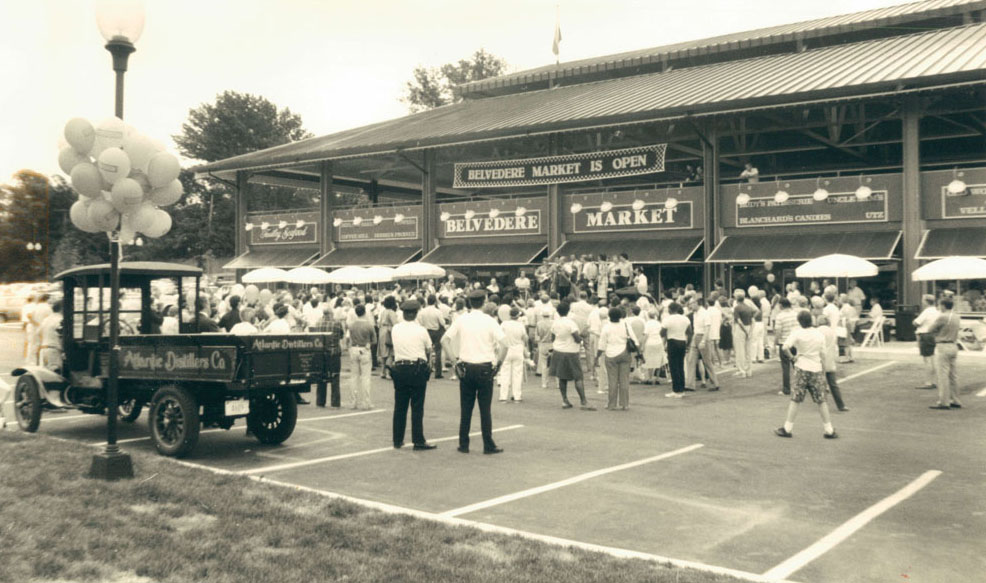
Grand opening, 1986 (The Baltimore Sun)
Elizabeth Magie, Monopoly’s inventor, was one of the first game designers to format the board as a circuit around which players loop until the winner is declared. In Baltimore, it’s easy to trace that loop, with developers circulating through advantaged white-L neighborhoods (except when they build their own luxury islands). Someone else will land on Belvedere Square soon enough. Magie intended for people to play the game according to her now-forgotten “prosperity” rules, in which generous taxes on land and rents are redistributed for public goods determined by all players. For instance, players could nurture the actual public markets and common spaces which Belvedere Square merely evokes, and give everyone pizza. Stories about Monopoly’s unexpected origin tend to assume that this version was incredibly boring and no one wanted to play it. Pizza Club would definitely agree. Why play a game when you can share real pizza?

6/8 slices

Research and photographs: Graham

Wednesday, May 25, 2016

Imitations of metropolitan splendor

Pizzatella of Security Square Mall
6901 Security Boulevard, Baltimore, MD 21244


The southern annex of Security Square Mall, with almost 100% vacancy, frozen escalators, and piles of 90s-era debris accumulating behind burned-out karaoke-club neon, is a harbinger of the post-apocalyptic future in which squatter communities repopulate America's abandoned suburban retail habitats. The mall's central body remains vibrant despite this ghostly appendage; indeed, passing from the hollow, dust-marbled pall of the annex into the main commercial avenue, one feels like a dead soul rudely shaken back to life. The mall's classic design features – luxuriant terraces of tropical plants arranged beneath domed skylights like a cartoon version of nineteenth-century hothouse architecture – gestural fake cornices masking ventilation pipes – invites visitors to take their leisure and edification among the miniature retail environments occupied by slightly off-brand replacements for the major national chains that fled Security Square for newer strip malls. There's a cavernous inflatable-jumping-structure palace for children's parties, a popular Japanese buffet, and a custom menswear shop currently stocking Hawaiian-print suit jackets for summer.


There's also a food court with slightly-askew versions of standard food-court fare. Heated tureens of Chinese noodles glimmer with the promise of the familiar. Up close, things are not what they seem. Pizza Club gravitated towards a jazzy-looking sign for “Pizzatella”. Vaguely evocative – is it a reference to mozzarella? Or piatella, an uncommon Tuscan bean? Pizzatella has customized its niche in the food court panorama with a fake brick oven formed by building a box of red tiles around a normal stacked stainless steel unit, and with some close-up images of Italian food postered on the wall. Multiple flat-screens also show surreally saturated images of pizza.


Pizza Club obtained two huge and perfectly-sliced wedges of cheese and pepperoni pizza. Its shine was so blinding that it may have been a mirage. Scott carefully tracked the progress of this grease through the pies and thence through the layers of paper plates. We found the cheese elastic and toothsome – plausible as real mozzarella – but quickly on the heels of this texture came a chemical aftertaste, suggesting a synthetic cheese whose oil had separated out during re-heating to form the above-noted oily sheen.


The crust was white bread in style, but perfectly toasted and crunchy when fresh from the fake-brick oven. As it cooled, it got chewier and heavier, until the remnant crusts began to weigh down the greasy plates and sag through the vinyl-top tables, pressing towards a dense gravitational center under the mall made from decades worth of agglomerated uneaten pizza crust.


Scott posited that we had just consumed white bread with marinara sauce and American cheese, distorted by the mall's occult aura to look like a fresh, delicious slice of pizza. “My hunger is satisfied, but I'm not sure how I'll feel in an hour,” he stated. In an hour, would he even be the same Scott? Something resembling daylight filtered through the glass dome, amplified by wrap-around mirrors in the ceiling -- the consumer simulacrum of a Crystal Palace -- or a museum of natural history filled with processed cheese.


3/8 slices

Wednesday, October 28, 2015

Halloween special: a tale of the ragged pizza

Italian Pizza Kitchen
4483 Connecticut Ave. NW, Washington, DC

Pizza Palace
410 Lincoln St, Rockville, MD

Beware the golden aura of overgrown drainage ditches passing by the MARC train window. Pizza Club is easily mesmerized this time of year when all sorts of influences are abroad on the wind. We were compelled to travel to the nation's capitol under such a geomantic power. Unfortunately, Pizza Club was going the wrong way, which we didn't realize until the conductor informed us that the MARC also runs to Perryville.

Why does the MARC system go where it goes? Why is Baltimore just a waystation along one wing of this fraught, frayed transit “V” that converges on Washington? A thread of dilapidated rail serves for the DC commute, but if Baltimoreans find employment on that fabled "Technology Corridor" to the west, they find no spoke leading from the gem of the Chesapeake out to Silver Spring, Columbia, Rockville, Gaithersburg, and the like. Hub-gravity eludes us – you must pass through DC or perish.

Many claim that another, better-connected metropolitan region is possible, but few apprehend the peculiar way in which it already exists. Baltimore has long felt the occult push and pull of suburbia. Space and time collapse in the force field of strip mall simultaneity; vibrant commercial matter coalesces in Canton Crossing as it decays on Security Square Boulevard. One can unknowingly bi-locate between a pizza dive in Timonium and one in Rockville. The same goes for the glitzy brick-ovens of Harbor East and those of DuPont Circle. Pizza Club has traversed the poles of the pizza Rota Fortunae and returned to tell the tale.

 I didn't actually go to Perryville because the very kind MARC engineers let me switch trains at Martin State Airport. There was a parking lot, a series of chain-link fences, and a rusty barbeque grill. I hung out in the crew trailer while everyone got drug tested for random drug testing day. I didn't have to participate because they assumed I was high, which was incorrect, I was just really absorbed in Nicholson Baker's description of tying his shoelaces and got on the wrong train, which could happen to anyone. Eventually an empty, nonstop MARC carried me to DC in its streamlined nose. Passing all the familiar commuter stops at full speed, we accelerated onto an extra-dimensional plane, the channel used mostly by thoughts, odors, and spirit animals, where there's always room to put your feet up on the upholstery.

Briefly flitting through the gilded circle of DuPont, I proceeded to rendezvous with a Pizza Club quorum in the wild and dreary Forest Hills. There, perched on the lip of a dignified suburban refuge, is an Italian Pizza Kitchen. Italian Pizza Kitchen sounds like a chain, but doesn't seem to have other locations. The neutral moniker establishes rapport with people in DC who gravitate towards unimaginative things. However, it lacks the uncanny tastefulness of your standard DC fast-casual restaurant secretly underwritten by Kraft Foods. Maybe it's just a pizza place, I have to do more research.

The encouraging Eastern-European staff made up a nightly special for us. We obtained a mushroom and garlic pizza with whole roasted cloves of garlic winking at us from a bed of mozzarella. This pizza achieved a pillowy crust with a meaty balance of mushroom savor. Then we watched a soundless documentary about pointy buildings in Bavaria projected on the wall behind our table. The solid scouting of Pizza Club alumna Katy saved us from the chasm of high-end fast-casual simultaneity. Gallons of cannoli cream that came with the nightly special anchored us firmly to Connecticut Avenue.

A cool stateliness, hinting at contempt only in its ornamented reticence, characterizes DC's Northwest suburban gradient. Pizza Club found diplomatic accommodations within the wood-paneled walls of a haunted 1960s Swedish embassy. However, the weight of history personified in a golden cherub-chandelier by our bedside took on spectral animation in the midnight shadows. We awoke with a desperate urge to flee that place, and history, towards an open vista of highways, parking structures, and desolate civic plazas. We had to go to Rockville, where the past is a distant nightmare because the entire city has been demolished and redeveloped at least five times since then.


Pizza Club ventured on foot into the winding suburban expanse seeking a place called Pizza Palace. Instinct led us onward through the dim, warm mist, past morbidly-decorated lawns and drifts of vivid but dead autumnal leaves. Suddenly we reached a clearing in the residential grid, and a wind swept away the fog, revealing a parking lot and a strip mall like a row of perfect artificial teeth. Each tooth had an identical glass face with identical food offerings: bread, chicken, steak, cheese, potato, and a deep fryer to meld them all together.


Pizza Palace belongs to no decade or region; it offers both low-calorie pizza and stuffed-crust pizza. We ordered the latter, honoring the ingenuity of those pioneers who first figured out how to put “ribbons of awesome hidden cheese” inside a pizza crust. It's still delicious, offering a differently-textured experience from the pizza's middle expanse. This cheese has been sheltered, coddled, allowed to retain its original ropey arrangement of lactose fibers.


The pie also had some toppings – perhaps Greek – which we found pleasantly abundant but inconspicuous. A baseline plain pie was absolutely standard in every way. The crust was bready and crisp enough to support a healthy slather of well-browned cheese atop a sweet unseasoned tomato sauce.


We asked the Palace's proprietor if there was any distinctive P.P. product we should try. He answered that the “Philly cheesesteak” pizza was popular. A man sat alone by the window eating a large plate of French fries, unadorned.


We breathed a sigh of collective relief – on this neutral ground we could once again attune ourselves to the subtler vibrations that would carry us back to the fringes of Baltimore. Passing through a heavy pall of darkness and nonentity, we rose above the grease-sheened ductwork of the Pizza Palace. A strange procession of failed urban renewal projects rose and fell before our eyes. The retail paradise of Rockville Pike receded – with a galvanic shock we found ourselves back in Baltimore and bent our steps eagerly towards home.

Italian Pizza Kitchen
6.5/8 slices

Pizza Palace
4/8 slices

Photo credits: Graham
A Tale of the Ragged Mountains: Edgar Allan Poe

Monday, August 10, 2015

The life and teachings of Serpico reconstructed by critical historical methods

Serpico Pizza and Pasta
10 Fila Way
Sparks, MD

Serpico has been called "the best cheese pizza north of Shawan Rd." Consider that if you keep going north, you get to York, Pennsylvania and thereafter to New York, where they have much better pizza than will ever be available in the vicinity of Shawan Rd. Is Serpico the "closest thing to an authentic New York-style slice" available in Maryland? Well I ate a slice of pizza with spaghetti on it and then more crust on top of the spaghetti. Do they have that in New York? Probably somewhere, yes, they probably do, because they have everything in New York, including better pizza than suburban Maryland.


Serpico is located next to a "Saddlery," where I think they make saddles for horses. We are in the rolling countryside particular to Maryland, a completely domesticated but unfussy pastoral. It's casual, just like Serpico's Italian dining. The people there were very nice and helped us choose an appropriate array of pizza slices. They sell by-the-slice, which is how they got me to try a "spaghetti pizza" -- it was the only thing fresh out of the oven when we walked in on a Sunday afternoon. The slices are very large in surface area; a modest but not indecent amount of grease pools in the depressions.

You'll want to stop here on your way back from swimming, tubing, or boating on the Gunpowder River and points north, because you'll be hungry but not ready to trade in the grid-less rambles of the afternoon for the strip malls of Hunt Valley. Take in the innocent dusk of Sparks, Maryland while it lasts. Across Fila Way from the plaza housing Serpico, a row of vinyl-sided, as-yet-unoccupied new homes stands on a ridge named "Fox Terrace" or "Fox View" or something with foxes. Pizza Club predicts that the children raised in these homes will often walk to Serpico and gaze upon its mural of the Cinque Terre, and think about going to Italy some day maybe for a school choir competition.

The crust was pretty good, crispy and thin but well-structured. The sauce was rounded and unobtrusive. There was cheese on it also. There is no New York slice to save us now. The historical "New York slice" never existed, it didn't die for us, it just never existed. It's a convenient lie told by generations of suburban pizza parlor proprietors to win the allegiance of the damned. In a countryside so abundant and gentle as Maryland's, one can happily believe that the world was created for us and types of pizza were ordained by a loving God. One can ascribe direction and agency to history. But our world is an accident and history is a tool of the powerful -- I suspect that people from New Jersey know it better than all the rest of us and they just aren't telling. Instead, they're driving up and down this blessed nation with their smartphones, producing a Yelp apocrypha of the one true pizza of which Serpico's is a fragmentary gospel.

4/8 slices

Tuesday, July 14, 2015

Pizza Club in Exile: Landscapes of Denial and Pizza in the Suburbs of Northern Virginia

Mario's Pizza
322 Wilson Boulevard
Arlington, VA

The suburbs of northern Virginia exude a particular terror: clean and new, built for people who don't want to live in a place previously inhabited by other people. The immense condominium complexes that stretch for block upon block in centers of “urban village” development around Alexandria, Arlington, and Tysons Corner turn their glass faces to the highway proclaiming transparency – walls of windows, the light of truth, a world without history, and a "Corner Bakery Cafe" on the ground floor. 

Crystal City skyline. By Kevin Bowman
 
Do they qualify as “edge cities”? They balance on the knife blade separating the visible universe from a dark covert universe of lies. When confronted with this phalanx of architectural obliteration one feels the dropping-away of solid earth. No less than the man-made islands of Abu Dhabi, this built environment is pure liquidity temporarily stored in concrete and steel. Listen closely and you can hear the flow of capital cascading into a bottomless void that opens up underneath the Pentagon City Metro station. These sites are worse than haunted. With signals scrambled and the map wiped clean, the dead have nowhere to rest; they and their secrets are caught in that planner's darling, the traffic-calming urban roundabout.
 
The whispers and spectral visions that visit me in the suburbs of northern Virginia are not, however, incompatible with eating pizza. Pizza is a cornerstone of Cold War American empire and as such belongs in NoVA as much as transplanted Iranian real estate moguls and Salvadorian refugee day-laborers. There's a pizza place called Shakey's that people who grew up around here remember fondly, but it's gone now, but at least they can remember something. Other pizza joints in this mold live on. They are frozen in a moment of 1960s suburban exuberance about pizza: we take bread, add a mealy tomato broth spiked with oregano, and overlay a slab of mozzarella white, flat, and thick as the grave markers at the nearby National Cemetery. 

 
Today's pizza palace of yesterday is Mario's in Arlington. Mario's is located on Wilson Boulevard – Wilson Boulevard, for our 28th president, a man who believed that foreign policy must spread democracy using a variety of means. On the other side of Wilson Boulevard is a thicket of condos. A Pizza Club observer describes “[an] unsuspenseful Rear Window… revealing frat boys playing beer pong and large flat screen TVs illuminating darkened rooms.” Transparency is meaningless, under the surface there's just beer pong in a condo lounge on a Saturday night. 
 
Mario's models the mid-century roadside dairy shack vernacular, low-slung building, towering swoopy light-box signage. Carvel ice cream novelties come from a front window, pizza comes from a counter inside where different people will talk to you and shout your order at each other until someone makes you a pizza. Pies emerge onto outdoor picnic tables over which darkened human forms hover. In the Arlington twilight, mozzarella catches the neon glow.


The pizza is a rectangle, rolled out with a rolling pin. Many compared it to “French bread” pizza products found in the frozen food aisle. Locals explained to us that Mario's pre-bakes, tops, and then bakes again for speedy order fulfillment. The crust is thick, bready, and chewy; it begins to dry out after the ten-minute mark. There's not much sauce to help you deal with this, only cheese, so much cheese. And toppings if you get them. They're under the cheese. It's not fake, it's just the inoffensive American idea of mozzarella still often spotted in elementary school lunches. The term “cheeze-lastic” was proposed as a descriptor. It recreates the flavor landscape of its time -- a flat line rather than peaks and valleys. Cookbooks were casserole-based, acceptable spices were salt, pepper, and oregano.
 
Mario's has been in this place for fifty years circa 2007 when they put up a sign to that effect. Why in the throes of a deep and abiding unease did we gravitate towards its lights? Among the history-swallowing anti-monuments of NoVA Mario's stands as a witness to precisely those decades when America's relationship with the past imploded in a mushroom cloud of denial, anger, and ignorance both willful and imposed. How fucked up was it? The quaint hamlet of Arlington was home to an “American Nazi Party" which picketed the local pizza parlor for serving African Americans and Jews; the year was 1961. Mario's, along with the rest of the town, reckoned with these bizarre hate-mongers in their midst until the 1980s. You can still eat essentially the same pizza that sort of stood up for Civil Rights because the pizza survived while the hate group bit the dust. 


Further reminisces confirm the Mario's pie as a historic survival. “This is old-school pizza you're not old enough to have a memory of,” a Pizza Club gen-Xer admonished the scribe. “It feels like I'm on a beach vacation when I was ten years old,” another remarked. “I grew up on this stuff,” our local informant added, instructing us in the proper microwave revival technique. You might be tempted to reheat this pizza in a toaster oven, but only microwave radiation should be used for period accuracy. 
 
Mario's rescued Pizza Club from a serious paranoia trip. We want to touch the good and evil of the past, we want to feel something (cheese) in the pit of our stomachs. By all means build the progressive dense “urban suburb” of the future and build it here where it can help the maximum number of people commute to work in defense contracting. But know that the sleek visibility is false and the transparency is an illusion – you'll only glimpse the truth in the distorted gleam off an expanse of Mario's mozzarella. 

5/8 slices
Pizza photo credits: Katy  

Monday, January 27, 2014

Arbutus: Pizza Paradise of the southwest

"The meaning of pizza is convenience"

Pizza Paradise
5411 East Dr, Halethorpe, MD

Sorrento's of Arbutus
5401 East Dr, Halethorpe, MD

It's suburban Maryland: neighborhoods, schools, nameless warehouses, seafood shacks, strip malls, installations of the security state, shining white surveillance blimps overhead. Where to get pizza? Nestled in the crook of I-95 and the Beltway is Pizza Paradise. It's a convenient drive from both UMBC and the National Security Agency's Friendship Annex.

I read some Yelp reviews of Pizza Paradise, where people claimed that the pizza poisoned them and their dogs and mutated their genes such that their offspring were born horrible frog-creatures. This isn't true. I mean, I didn't see their frog-creature offspring since Arbutus was pretty deserted on Tuesday night, but the pizza was fine.  Most of these reviewers recommended going to the Domino's Pizza across the street from Pizza Paradise, which helps us understand where they're coming from, and why we should not listen to them.

Pizza Paradise is a large open shack-style establishment with humming overhead lights, dingy booths, and gigantic maps of the delivery area taped to the walls. We drove through the deep-frozen polar vortex night to get there -- everyone else was busy plundering Safeway in preparation for an expected five inches of snow -- and it's dark out there in the suburbs, and the windows of the houses are like cold dead eyes.  The main drag of Arbutus, around the intersection of Sulphur Spring, East Dr., and Oregon Ave., was thankfully illuminated and showed signs of life.

"Sometimes the crust even sprouts bubbles, allowing for a light, flaky consistency that will have anyone coming back."
 The proprietors of Pizza Paradise were friendly and joked with us as we wavered indecisively over the menu. They offer some specialty options, but the word on Pizza Paradise is that the sauce is the most important thing they do, so we ordered a cheese pie to get a clean sample. After a few minutes wait, we were served a pizza that was crisp on the bottom, soft and chewy in crust, and topped with a subtle but spicy sauce. "I would definitely get takeout if I lived around here," Katy said. "It's a little greasy, but in the way that you'd want it to be." Layne noted that the grease seemed to emanate from the molten cheese -- i.e., naturally-occurring rather than poured on top, as some places feel compelled to do. Katy had eaten at Pizza Paradise before and remembered the sauce being spicier, but upon eating a leftover slice the next day, she reported that it increases in spice when chilled.

Among the few people we encountered in Arbutus were a gaggle of local teens who came into Pizza Paradise for chicken cheese steaks. They were confused about why we were talking to them, but expressed positive feelings about the pizza. It is not excellent pizza, but it's better than a lot of the corner take-out places in Baltimore, and the spicy sauce makes it "a little bit special."

Sorrento's veggie (L) and shrimp (R)
 Since we came all the way to Arbutus (or Halethorpe -- which is it? Different maps and signs say different things), we decided to sample another one of its pizza sources. A block down from the humble Pizza Paradise is a large, shiny, "family style" establishment called Sorrento's. Sorrento's has been around since the 1970s, and seems to be a good citizen of Arbutus, with many ye olde photos and portraits of local notables on its walls. Sorrento's is more of a hangout, with beer on tap, lots of booths, a small arcade area, and a stack of those gumball machine things with toys in them.

Gazing into the future of the past
 This was definitely a more comfortable place to hang out than Pizza Paradise, which mainly does delivery and pick-up. However, their pizza, like the establishment itself, reflected a 1970s understanding of food. Pizza Club thought that the crust was both too thin and too doughy, and was covered with too much of an "unremarkable" sweet tomato sauce. They offer many special pies overloaded with toppings, which is what American pizza does to convince the customer of its value in the absence of flavor.

"Styles, colors, and sounds."
We ordered a veggie pie, which fell into the "salad-on-a-pizza" category; all the ingredients were fresh, but the pizza underneath them was not worth eating, so why not just get a salad if you want to feel healthy. The other pie, plain cheese with shrimp, had good shrimp. Why not just eat shrimp with a piece of bread?

"Pizza is a magical thing in the hearts and minds of men, women, and children."
What would a Pizza Paradise actually look like? It seems that one person's Pizza Paradise could be another person's Pizza Hell. My understanding is that Pizza Paradise is a kind of quest, calling us ever further from safe, familiar harbors, out into the unknown, wandering blindly through the suburban night.

Pizza Paradise: 4.5/8 slices
Sorrento's: 4/8 slices

Thursday, December 12, 2013

from the deep pizza archive: earth wind & pizza

Life is so full of things that are not even pizza. I guess you can focus on material gain and professional advancement. Some people breed exotic cats. But where is the dignity in any of that? The plain old fashioned basic human dignity to which each of us is entitled by virtue of being born? The only way is to get back to pizza.
I don't even remember how long ago this meeting of the Pizza Club was, probably like May or April or something. Someone on the internet suggested that we go to Earth Wood & Pizza, which is up Falls Road past Mt. Washington and Robert E. Lee park, where there's that place that sells frozen yogurt, and a crepe shop, I think. Mark Twain says this about the spring time: “It's spring fever. That is what the name of it is. And when you've got it, you want—oh, you don't quite know what it is you do want, but it just fairly makes your heart ache, you want it so!” 

We exited our parked car in the icy suburban breeze; we wanted pizza. The place had a "furniture store vibe," the makings of a franchise perhaps. Apparently they coal-fire their pizza in a thing called a Josper. Why is it called "Earth Wood & Fire" if there's no wood in the fire? What is a Jasper?
We felt that this pizza suffered from some overcooking of crust. This might be a risk of using a Josper, which I think is a bit like a grill. Some people like those burned bits of grilled food, but it is problematic with pizza because it can stiffen the crust too much. They also offer a whole wheat crust, which was pretty respectable for a "healthy option" but got even drier and crunchier than the regular crust as a result of the Josperization process.
 The broccoli-topped pie that we ordered had its broccoli cut into perfectly-sized florets, so they didn't burn in the Jasper. The other vegetable toppings were also good.  The real question in everyone's mind was, how was this pizza made? If a Josper is so great, why does the pizza taste mediocre? Is a Josper a fancy kitchen gadget popular among people who fill their kitchens with vintage espresso machines? 
 If you tried to dig a hole through the center of the earth, would you encounter a Josper?
A Josper is actually a sub-genre of Gothic fiction. Fortuitously, we brought along an English PhD who was able to identify the telltale Gothic themes: abandoned castles, lightening, the hollow earth, marrying your cousin, marrying your boss, hysterical blindness.
This pizza wasn't really good. We gave it 5.5 out of 8 slices. When we got there we were really hungry and looking forward to pizza; we left with our stomachs full, but we did not feel spiritually full.