Showing posts with label fast-casual. Show all posts

Friday, July 26, 2019

Pizza prosperity


Pizza Trust
Belvedere Square
529 E. Belvedere Ave

Pizza Club (not its individual members, but the disembodied collective voice of Pizza Club) does not like board games. Pizza Club does not understand board games. Why are they played? What is the source of enjoyment? Especially Monopoly. Monopoly makes us weep with mystification. We were reminded of this when reading up on America’s first Gilded Age, in the last decades of the nineteenth century, which served as the model for that dreaded game. It was a time of unbridled corporate power and greed, dominated by gargantuan trusts – Rockefeller’s Standard Oil, J.P. Morgan’s US Steel, the Northern Securities Company which briefly owned all the railroads from sea to sea – crushing workers and consumers alike under their heels.


The game of Monopoly, originally intended to make people question the moral legitimacy of this system, famously did the opposite and taught us that cutthroat real estate dealing is wholesome fun for the entire family – which it is, ask Jared Kushner. The abstracted pantomime of the “game,” where everyone starts equal and obeys the same rules, helps our brains accommodate the obscene exploitation of bodies and resources that we observe in the real world. When people threaten to take away the obscene exploitation of bodies and resources, that is called socialism, and it’s the most frightening thing imaginable. There would obviously be nothing left to do that is “fun” under those conditions.

These thoughts bubbled to the surface of Pizza Club’s melty cheesebrain as we visited Belvedere Square, a shopping center just inside the city’s northern limits. In that place has arisen the headquarters of a great Pizza Trust which claims to serve “Baltimore’s best pizza.” The Pizza Trust began operations about a year ago, which makes it quite remarkable that they have already received the designation of “best pizza” from the Pizza Oversight Authorities. Perhaps they acquired some smaller pizza company which came with this superlative, or perhaps the wheels of justice have been greased. Our investigators did turn up an unusual amount of grease, but we conclude that the Pizza Trust is in fact a whimsical evocation of corporate monopoly, and actually controls no means of production beyond the equipment and materials in its humble rented stall. We will first speak of these greasy materials, and then of the game in which the Pizza Trust merely occupies a square within a square within a square. Within a game board that is also just a square in a larger gameboard! Oh my god!


To set the scene, we should clarify that Belvedere Square contains numerous retail spaces arrayed around the large postmodern shed designated “Belvedere Square Market” (the rustic roof conceals a parking deck). The Market is modeled on the public markets of olden days, where various food producers would gather to sell their goods. In the early 1980s, white suburbanites nostalgic for the downtown public spaces they remembered but were afraid to visit built simulacra such as this. The Market offered heavily marked-up produce, meats, dry goods, etc. alongside prepared foods. Today, however, wealthy people have raw foodstuffs delivered to their homes in elaborate plastic sarcophagi; we don’t really know how poor people get food but many of them seem to still be alive. The only reason the bourgeoisie go outside is to visit food halls, and Belvedere Market transformed into the city’s first food hall in the early 2000s with a few gentle strokes of the Invisible Hand.


Though Pizza Trust is not the best pizza in Baltimore, it’s the best pizza we’ve had in a food hall. If in the future the city becomes one giant mixed-use megadevelopment with a food hall on the ground floor/pontoon level, we would nominate Pizza Trust to go there.

The Market Pie (a metonym for the place that used to sell vegetables but now sells only this prepared food with vegetables on it)

Don’t be appalled, dear reader, but Pizza Club doesn’t really want to write about pizza. You should know this by now. We are only continuing the work that began long ago, and will continue as long as cheese exists. Here it goes: the pies at Pizza Trust are oblong and would furnish a meal for two people. You could eat one by yourself if necessary. They offer a creative array of specialties, some quite beautiful in appearance, shimmering with greens, yellows, and reds.

The Mobtown
 The crust is thin, “gentle and light” but with “enough thickness and moisture to be satisfying,” forming a dynamic gradient from soft to crunchy. It has charred spots which release carbon flavor like delicate wisps of smoke. We experienced premium cheese and toppings and inventive use of sauces. Notably, the “Market” pie has a roasted red pepper and carrot sauce that pleased club members, providing the sweetness of a tomato sauce but with an unexpected rooty profile that compliments parmesan. The distance between pepperonis was just right.

Pepperoni (did not write down funny name)
 The specialty pies, though coherently planned around distinct flavor profiles, sometimes indulged in excess. The “Mobtown” balanced so many ingredients that they “rolled off the slice” and left the center of the pie rather damp. “Truffled white sauce” poured from a mushroom slice “like the frosting on toaster strudels.” The mushroom pizza is unpleasantly named the “Funcle”. Also, “truffled.” Why “roasted wild mushrooms” when you have roasted regular mushrooms? It’s fine to just say mushrooms. Your expensive words do not please us.

Funcle
 Quibbles must be aired through the Pizza Club consensus process, but in the end we were very happy with our pizzas, ranking them above other local “fast bake” fare. You don’t go to a food hall specifically for pizza; rather, you go for the scenario of curated choice and once in that scenario, you decide that you want pizza and locate the designated pizza vendor. One Club member spoke of Pizza Trust’s pie as a flattened version of the ubiquitous fast-casual “bowl” format. If you live in the neighborhood, it could be your first-line pizza place – it will make you feel healthier than Pizza Bolis because there is less food. We also appreciated that the pies were quite affordable for this sector of the market – between $10.50 and $12.50 for pies comparable to those which cost $15-$18 at other Neapolitan-style outlets. We have received reports of significant lines at the Pizza Trust during mealtimes.

“Order ye pizzas while ye may,” advised the poet, and so must fans of Belvedere Square do. Pizza Trust has lightheartedly appropriated the “trust” as a vintage aesthetic; the age of railroads and Rockefellers is a funny reference for a local small business staffed by very courteous teenagers. Yet the game is still afoot, and the rent comes due every month. Many businesses have left Belvedere in recent years, finding that even premium prices and a baked-in clientele can’t satisfy this obligation. It’s just another spin around the same board.


The first Belvedere Square was built in 1986 by developer James Ward, II, with a $1.7 million loan from the city which Baltimore forgave twelve years later. By then, many shops had gone under and Ward wanted to switch from local businesses to chain-store tenants – he wound up shuttering the entire site after drawn-out conflicts with business owners and neighborhood groups. A consortium of big-name developers got $4 million from the city and state to redevelop the site in 2003, and Scott Plank’s War Horse LLC launched another rebranding in 2013, building his resume for future bids on public markets around the city. This is a very interesting game in that millions of dollars in public financing magically rains down upon its wealthiest players whenever they roll the dice. War Horse has put the site up for sale again; Plank prefers his assets liquid. We recommend the “truffled white sauce.”


Pizza Trust seems not unaware of this context. “Like historic Belvedere Square Market,” their web copy declares, “The Pizza Trust is an instant classic.” Truly we have no time to wait for history to happen – we must will a fictional past into being, instantly classic, and continually renovate that past to track market trends. Would you get emotionally attached to a square on the Monopoly board? The game was supposed to teach us that losing things is fun. That way we can enjoy the random possibility of winning something new, or getting crushed by those who are winning.
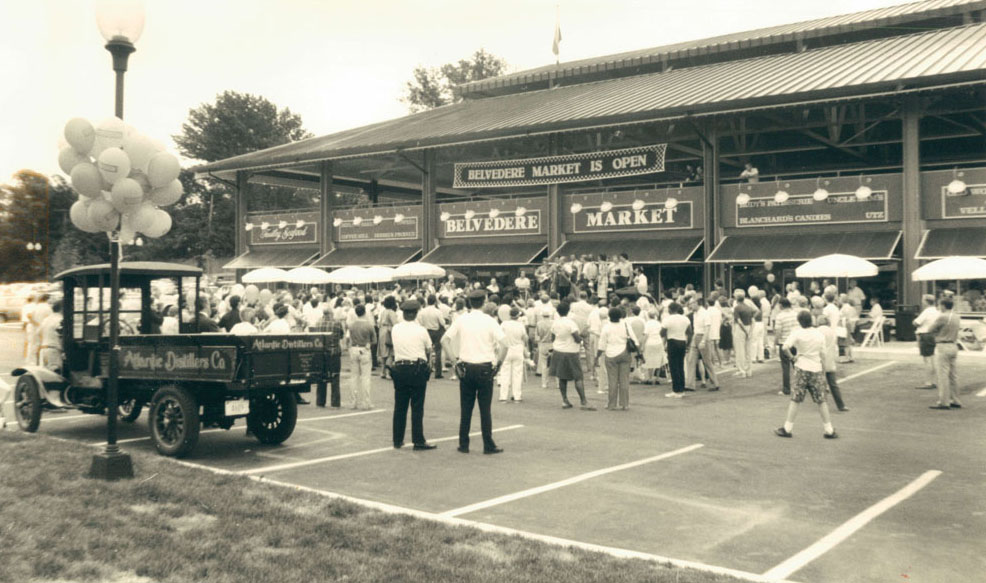
Grand opening, 1986 (The Baltimore Sun)
Elizabeth Magie, Monopoly’s inventor, was one of the first game designers to format the board as a circuit around which players loop until the winner is declared. In Baltimore, it’s easy to trace that loop, with developers circulating through advantaged white-L neighborhoods (except when they build their own luxury islands). Someone else will land on Belvedere Square soon enough. Magie intended for people to play the game according to her now-forgotten “prosperity” rules, in which generous taxes on land and rents are redistributed for public goods determined by all players. For instance, players could nurture the actual public markets and common spaces which Belvedere Square merely evokes, and give everyone pizza. Stories about Monopoly’s unexpected origin tend to assume that this version was incredibly boring and no one wanted to play it. Pizza Club would definitely agree. Why play a game when you can share real pizza?

6/8 slices

Research and photographs: Graham

Monday, June 6, 2016

Pizza Royale

Piezzetta
Horseshoe Casino Baltimore
Russell St.


It's great having a casino right here in Baltimore City. The casino's job is to create an atmosphere of luxury and excess that motivates you to spend money -- and moreover, makes you believe that you can win money from a system carefully engineered to take what you don't even have. For just one night, you can pretend you're the Mayor of Baltimore attending a real-estate developer convention in Las Vegas.


But this isn't Vegas. Baltimore isn't super committed to maintaining any illusions. Watch the Horseshoe Casino try: they put the set of Dynasty in a big box and dropped it from the sky onto the bank of the Patapsco, where it's surrounded by giant billboards for its suburban competitor, the Maryland Live! casino in Arundel Mills. The billboards urge motorists groping towards the Horseshoe's chaotic left-turn lane to just "keep driving". The Horseshoe's vast parking garage is an inclined highway; ascending its majestic heights, you can gaze down upon the self-storage center on one side and the city incinerator on the other. One of the first people who spoke to us was a guy asking for spare change or something to eat, bringing to mind the extensive homeless encampment displaced from the nearby woods by the casino's construction.

A sporting effort has been made to create an opulent interior, with elaborate multi-tiered light fixtures, custom-milled mahogany trim, and gilded drop-ceiling. This is a 24-hour entertainment destination for young, hip partiers, with local beers on tap and a live-music stage for millennials who prefer varied stimuli over the tunnel-vision of slots.

However, the floor plan tells. A small area for table games front-and-center at the entrance evokes the idea of a casino in old movies where well-dressed people drink fancy cocktails and engage in libidinous/criminal intrigue; beyond, a blinking ocean of slot machines opens out on all sides. This scene is just not sexy, but it's not the Horseshoe's doing. The industry seems pretty centered on slots, to the point where they give away free soda to keep people awake and pressing a button instead of free booze to loosen up their poker game.


Pizza Club's destination was the casual dining area of the Horseshoe, a pseudo-vernacular historic main street with hand-painted signs in distressed lettering, containing Guy Fieri's Kitchen + Bar, Lenny's Deli, and Piezzetta, a fast-casual pizza establishment. Restaurateurs created this pizza concept exclusively for the Horseshoe, though they plan to add more locations in answer to the nation's inexhaustible need for alternatives to Chipotle. Surely they will succeed at selling lots of pizza from within other stucco rectangles surrounded by ample parking and Disneyland evocations of the urban streetscape.  But the essence of Piezzetta's pizza is so casino-specific that it really should be experienced within the Horseshoe.


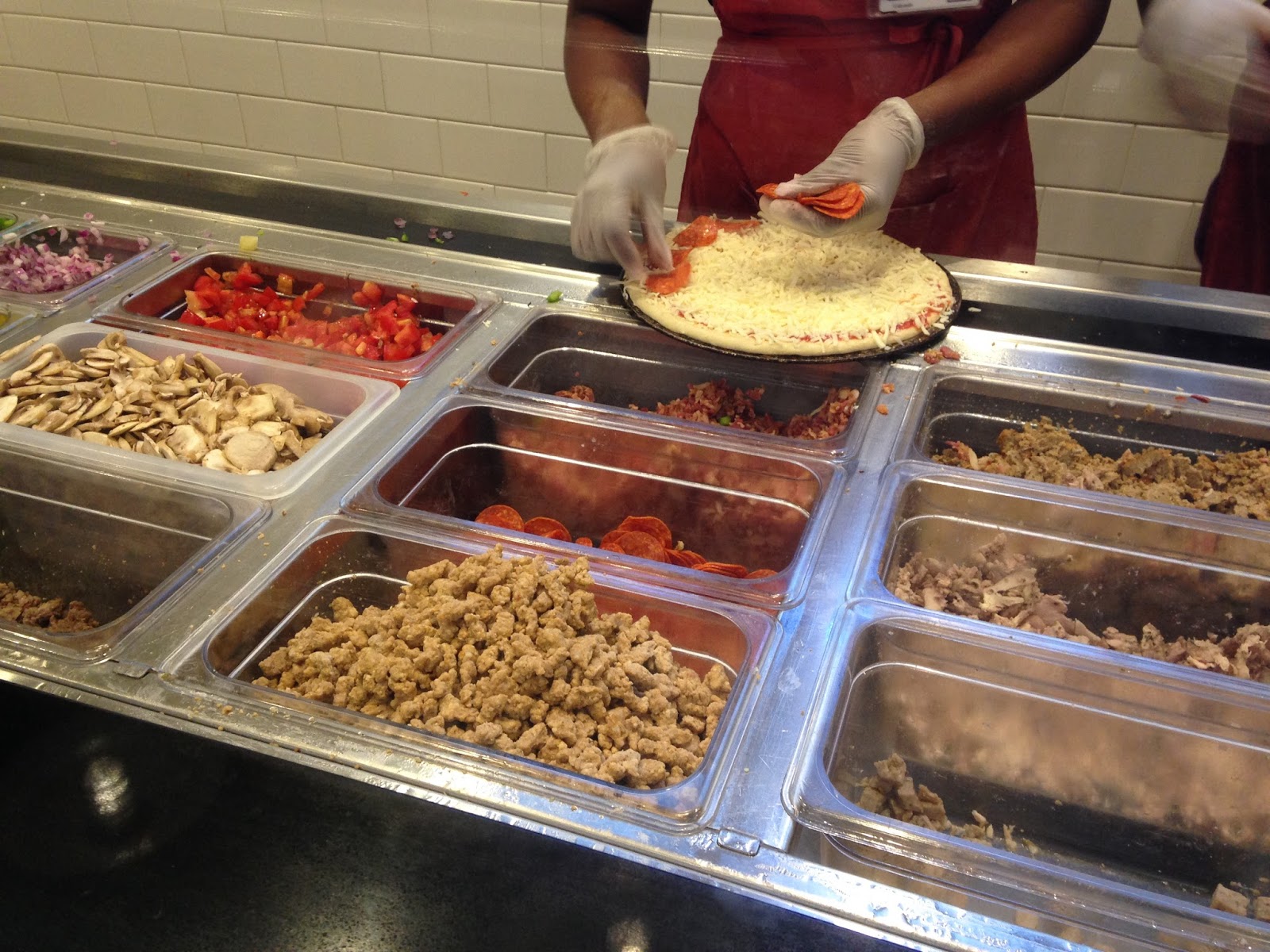
What we found inside Piezzeta's quaint brick exterior was a sleekly engineered workflow of custom order assembly. The pies are around 12 inches in diameter, awkwardly too large for one person but not enough for two. For $14 you can cover a standard crust with infinite toppings, or select a prefab specialty pie. Much like the casino itself, a facade of enjoyment gave way to a utilitarian exchange of money for the satisfaction of an addictive drive. 


Kate appreciated that Piezzetta, unlike its local competitors in the fast-causal pizza business, "isn't pretending. It's like, we're a fast food place in the casino but you can have some decent pizza. Pizza Studio is all like, 'we're your loving artisanal pizza artists'." A few humane touches, like a hanging roll of butcher paper with hand-lettered lunch specials, seemed advised by a consultant and were dwarfed by at least four huge flat-screens bearing the actual menu.


The special pies were kind of decorative and not really thought out. Ben enjoyed a "Pineapple + Pig" pizza but found it "wet..self-destructing, must be scarfed or abandoned." Similarly, Mike observed that "the wetness of the pizza encourages gulping it down quickly." A pesto and artichoke pizza left Kate "mad that I paid $13.99 for this. It's really oily and tastes like a drawing of pesto." (The pesto sauce in general was not recommended). The "Meat lover's", a giant pile of meat, was "meaty, greasy, decent, but undistinguished."


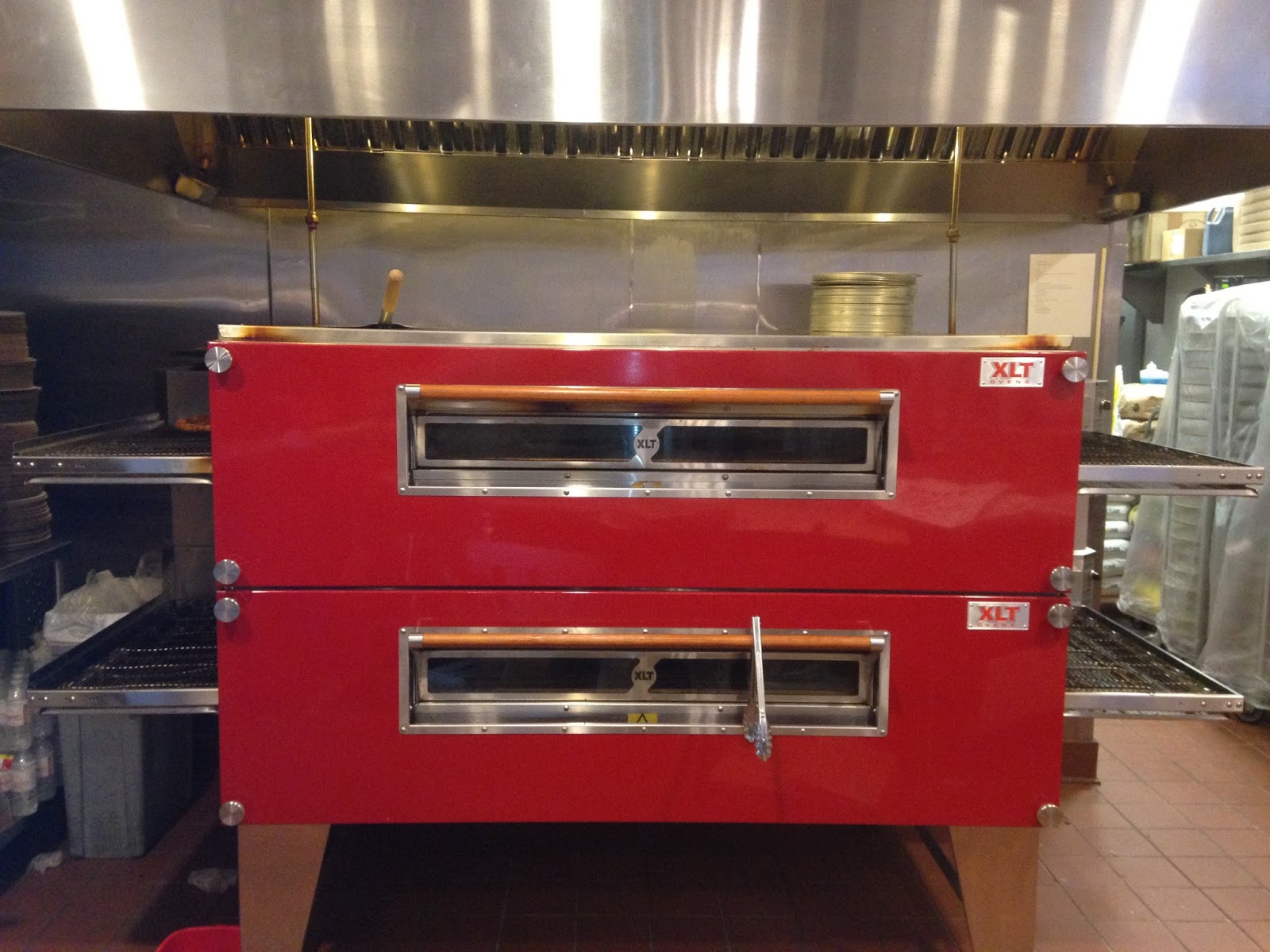
Instead, we recommend whatever impulsive combination of toppings you happen to point to when they take your order. Those who adopted this approach were overall much happier. "I like mine because it's exactly what I've always wanted in a pizza," Sophie explained. Piezzetta has their fast-casual game down to a science: individual toppings are fresh, of a high quality, and there's a lot of them. Everyone was excited about the "after-bake" options, a variety of flavored glazes and reductions. The availability of whole wheat and gluten-free crust also appealed to the health-conscious. In three minutes or less, raw pies run through a heat-blasting conveyor-belt oven cleverly decorated with fake doors to look like a traditional pizza oven.


The crust had a subtle, rich flavor, which many enjoyed. Piezzetta's dough recipe seems optimized for the assembly-line rapid bake process, so it doesn't bubble and crisp around the edges like a normal pizza crust would. Increased fat content, perhaps olive oil or butter, combines with decreased yeast activity to produce a crust that fades to soggy nothingness in the middle.

Glancing around a table of Piezzetta diners, Pizza Club observed rivers of grease running down everyone's hands and wrists. All the pies were literally sopping with oil. We don't know where it came from. It flowed through cardboard trays and plates and napkins like credit through a slot machine, but the grease was very real and would have made it difficult to operate any kind of touch-screen game while eating. Sophie made the best of it: "I've stopped trying to wipe the olive oil off my hands and now I'm rubbing it in and feeling super moisturized." Indeed, such luxuriant use of olive oil, a valuable commodity prized by the wealthy of ancient Greece and Rome and burnt as an offering to the Old Testament God, is not just a passive response to the generalized American craving for salt and fat, but an active ingredient in the potent consumer psychology of a casino. We felt satiated after the heavy oil injection, like no one was holding back on anything and we shouldn't either. "This place will find a way to give you what you want," said Ben, in relation to the pizza but also the casino generally.


We tried to play the slots but they're not wasting time on dilettantes like us. You can't actually put coins from your pocket into a machine to gamble -- you have to give it your credit card, entering a plane of frictionless, indefinite flow. The minimum bet for table games is around 25 bucks. Maybe we didn't eat enough pizza to rise to that plane, or maybe we ate too much and got bogged down by the aftermath of greasy unease. Back on the roof of the parking garage, we brooded on how the Horseshoe makes subtle contextual reference to the two nearby landmarks as a self-storage unit for humans and an incinerator for the funds that may or may not exist on their credit cards.


4.5/8 slices
Photo credits: Ben and Graham


Sunday, September 13, 2015

In the Age of Its Mechanical Reproducibility

Pizza Studio
3201 St. Paul Street
Charles Village


Pizza Studio's product is definitely pizza because Pizza Club “immediately recognized it" as such. We accept the evidence of our senses. But what subliminal machinations underpin this moment of recognition?  Even taste, smell, and cheese are constituted by a field of structural forces. The present is opaque to itself – “each 'now' is the now of a particular recognizability.” The people of Baltimore recently entered the now of infinitely-customizable premium-quality pizza served in under two minutes.


What's more, this pizza asserts its status as a work of art created by you, the consumer. Where the gates of Dante's Hell bear the inscription, “Abandon All Hope,” the gates of fast-casual dining entreat you to “Create Your Masterpiece."

Pizza Studio is a franchise “fast-casual” restaurant from California recently slotted in to the gleaming brick-and-glass arcades of the 3200 block of St. Paul, a block notable for looking and feeling nothing like Baltimore. Undergraduates can be observed through the plate-glass windows of Chipotle, Cold Stone Creamery, and Starbucks, enjoying the remarkable continuity of consumer experience made possible by the extensive geographical coverage of these brands. By substituting “a plurality of copies” for the unique existence of a particular place, they constitute a distributed zone of the familiar that empowers college students, families, tourists, etc. to move uninhibited through an 'urban' environment that would otherwise offer them few recognizable enjoyments.

There are already two pizza places in the Hopkins zone that should meet the needs of undergraduates, but they definitely haven't captured the current market. They don't belong to the particular recognizability of the now: freshness, 'local'-ness, hip design and branding, and the embrace of myriad dietary restrictions. They lack a story, ethos, values, or globally-oriented social commitments. Pizza Studio won't compete with any of the neighborhood pizza places – it's in the ring with Chipotle in a battle for which eight-dollar lunch-food spectacle can assuage the creeping bad consciousness of late capitalism.


Pizza Studio frees you from all limits and constraints as you queue up to order your custom pie. If you find yourself experiencing limitations, it's due to your own weak imagination and ultimately, your failure as an artist -- in which case you can select a pre-fab “Masterpiece” from a menu.


The fresh, all-natural components of a Pizza Studio pie flow rapidly through different stages of matter. As in the studio of a highly-successful contemporary artist, the transformation of raw material into art is carried out by assistants whose labor is not “creative,” and thus, effectively invisible. Since you, the consumer, are also the artist, you pay for the cost of materials, facilities, and cheery technicians to realize your vision under your supervisory gaze.


Also like a highly-successful contemporary artist, you the patron of Pizza Studio are plugging in to the front end of a cultural production apparatus with its back end in military R&D, management psychology, despoliation of the earth, and an endless chain of exploitative labor practices. Delicious all-natural ingredients and seamless customer service did not invent themselves. The employee motto of Pizza Studio is “SNAP” – “Sense of urgency, No excuses, Attention to detail, Pride of ownership.” This motto is inscribed in the frantic, slightly-unhinged slicing pattern of a Pizza Studio pie.


Samit Varma, one of the founders of Pizza Studio, spent eight years as a Navy officer on nuclear submarines before he got his MBA. His partner is a career corporate ladder-climber of successful food franchises like TGI Friday's. The duo billed themselves as “former Baltimore residents” for the opening of the Charles Village Pizza Studio, which means that one grew up in Rockville and the other lived in Owings Mills. Behold the mercenary reproducibility of the 'local' – witness the militarization of the artisanal – in a weapons-grade toaster oven that blasts your personal-sized pizza with 50-mph gusts of scorching wind generated by the beating of Satan's wings in the innermost circle of Hell.


 All of this is yours for seven dollars and change – another attraction in the college market which prizes the illusion of quantity. The actual quantity of food material on your pizza will not increase appreciably even if you select every topping. Pizza Studio is not stupid – economies of scale and scientific optimization underpin each casually-strewn handful of nitrate-free pepperoni. Consumer psychology revolves around a primal delusion of rational decision-making, the appearance of “deals” that give maximum value for money. Whenever you experience this instinct, rest assured, someone with a six-figure salary is laughing and snorting coke off a Pizza Studio to-go box emblazoned with the catchphrase “Your Hot Masterpiece”. 


 Since it is an important function of capitalism to deny us knowledge of our time and place – to produce a fully-realized phantasmagoria that masks the obvious material conditions of life – the presence of Pizza Studio on a Johns-Hopkins-owned block of Charles Village, Baltimore, Maryland, U.S.A. explains itself. “It's gonna suck when this creative artist space gets driven out by gentrification and Hopkins development,” one Pizza Club member observed.

Pizza Club quickly located the “Starving Artists' Wall,” really half a wall, in the back corner of Pizza Studio. The concept is to have local artists – presumed to be starving because we all know the difference between creativity-branded commodity capitalism and creativity the disease that makes you actually go to art school – hang their work in the restaurant and sell it to customers. This is great synergy because the theme of Pizza Studio is the mind-warping lie of the creative economy. Dwarfing the local art are numerous restaurant industry stock photo canvas prints with pictures of weathered, brown-skinned hands holding vegetables.


I ordered the requisite plain cheese pizza. I felt like a failure because I hadn't expressed myself using the infinity of options available to define my unique pizza identity. However, when the Pizza Club Power Lunch Team took a synchronized bite of our cheese slices, we all experienced the mysterious confluence of sensory cues telling us that this was, indeed, Pizza – a good-tasting cheesy bread object fresh out of a heating device. “I thought the crust was gonna be bullshit,” said one PC'er, “but it's not terrible crust.” We ate a wide variety of pies from the menu and from our own rich imaginations, all of which tasted like pretty good food.

The Pizza Studio banks on a psychic economy of additive flavor, where “flavor” feeds back into the creative expressiveness and perceived value of their product – what we might call a flavor-creativity-value complex. The crust has “no particular flavor” or texture. The unlimited toppings, which Pizza Studio fully expects you to pile on, are the building-blocks of flavor-creativity-value. Then there are “glazes,” bottles of liquid salt and sugar that you spray on top of the pizza to further boost flavor-creativity-value. We hardly noticed the difference in pies with gluten-free crust and vegan cheese because these elements – normally the foundation of a pizza – are purely structural, like the tortilla in a Chipotle burrito.


 All of this is a long-winded recapitulation of Pizza Studio's mission statement. They're going to be the Chipotle of pizza, which for some reason no one thought of being until now. If you like Chipotle, and you like pizza, you'll want to add this to your lunch routine. Like Pizza Club, you might ask, “do I have to acknowledge my guilt for enjoying a corporate franchised business?” To which we say, “Be who you are.” We had an excellent time at Pizza Studio eating fun, creative personal pan pizzas. We sated our appetites and returned to the office to make shadow puppets on the back wall of a dimly-lit cubicle until 5pm, when we went home to watch TV. One can only hope to move through today's phanstasmic creative economy like a Pizza Studio pie through its turbo-charged toaster oven, and emerge out the other side a certified Masterpiece.


5.5/8 slices

Credits: Scott (pizza photos), Graham (photos & research), and Kate (photos)